What Your RV Converter Does and Why It Matters
The converter in your RV performs a function that most owners don't think about until it fails: it takes the 120-volt AC power from shore power or your generator and converts it to the 13.2 to 14.4 volts DC needed to charge your 12-volt battery bank while simultaneously running all the coach's 12V DC loads - interior lighting, water pump, slideout controls, leveling jacks, furnace fan, and any other 12V device in the rig.
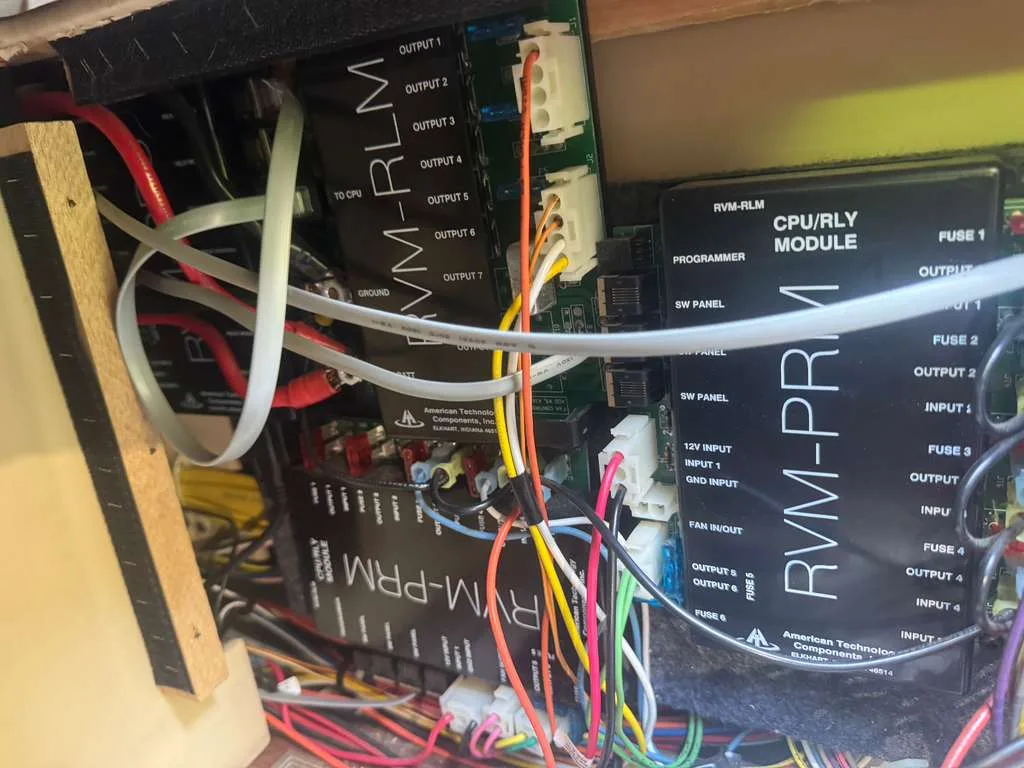
Without a functioning converter, you lose two things simultaneously: battery charging from shore power and regulated 12V power to all DC loads. The symptoms appear gradually - batteries that seem to always be low despite being plugged in, 12V lights that are dimmer than normal, slideout or leveling systems that move slower than usual, and eventually a battery bank that is completely flat despite being connected to shore power.
In Winter Haven's climate, converters fail from heat accumulation, water infiltration when shore power connections are poor, and simply from age and use. The constant 12V load demands of a Florida RV - running 12V fans, the refrigerator controls, the slideout seal conditioners, and the furnace ignition system even on warm nights - mean converters run continuously rather than intermittently as they might in seasonal camping.
Types of RV Converters and Their Failure Modes
RVs use two main types of charging converters.
Standard charger-converters (the most common in travel trailers and fifth wheels built before 2018) provide a constant charging voltage and are simple, robust, and often repairable. Their common failure modes are heat-damaged internal components from sustained high-current operation and water damage from condensation or campground moisture.
Progressive multi-stage charger-converters provide three or four charging stages - bulk, absorption, and float for AGM batteries, or the different profile required for lithium batteries. These more sophisticated units provide better battery care but have more complex electronics that can fail in more ways. Control board failures are more common in multi-stage converters when exposed to power surges or sustained low-quality shore power.
Diagnosing a Failed RV Converter
Converter diagnosis begins with measuring the output voltage at the converter's output terminals with the RV connected to known-good shore power. A functioning converter should read 13.4 to 14.4 volts depending on the battery state and converter type.
A reading below 12 volts at the converter output indicates failure. A reading of 0 volts indicates a complete failure of the AC input circuit, the converter board, or the output circuit.
We check the AC input to the converter - verifying shore power quality before concluding the converter has failed internally. A converter that is receiving low-quality shore power (below 108 volts AC) may produce low DC output even if the converter board is healthy. This is why measuring shore power quality is part of every converter repair call.
We also check the cooling fan on multi-stage converters. A converter whose cooling fan has failed will overheat under sustained charging load and enter thermal protection, reducing or eliminating output. A fan that runs constantly at full speed indicates the converter is running hotter than designed, often from a dirty cooling fin or blocked ventilation.
Converter Repair vs Replacement in Winter Haven
Simple converter failures - a failed rectifier diode, a failed output capacitor, or a burnt component on the main board - can sometimes be repaired at the board level. However, replacement is often the more practical choice for converters older than 8 to 10 years, because the cost of component-level repair approaches the cost of a new unit, and all the other aged components in the converter are at similar risk of failure.
Modern replacement converters offer significant advantages over older units: multi-stage charging that extends battery life, lithium battery compatibility (critical if you are planning a battery upgrade), and better surge protection. If your converter has failed and is more than 8 years old, we typically recommend replacement with a current-generation unit.