RV Inverters: What They Do and Why They Fail
An inverter is the reverse of a converter. Where a converter takes shore power AC and turns it into DC to charge your batteries, an inverter takes DC power from your battery bank and turns it into 120-volt AC power - allowing you to run 120V appliances (television, microwave, laptop charger, coffee maker) when no shore power is available.
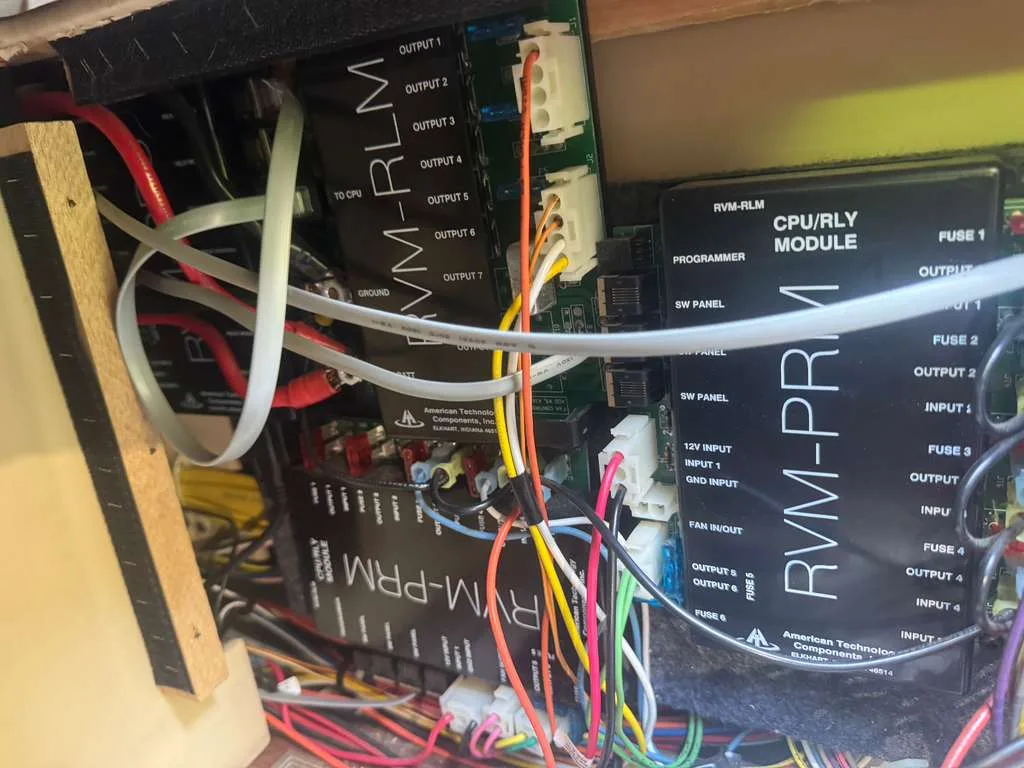
Inverters are standard equipment on some higher-end RVs and a popular upgrade on others. In Winter Haven's year-round camping environment, inverters get significant use compared to seasonal climates - boondocking at Lake Kissimmee State Park, at rural Polk County sites without hookups, or during generator downtime at campgrounds are all situations where an inverter provides critical 120V power from the battery bank.
Inverter failures tend to cluster around two causes: overload damage and heat-related component failure. An inverter that has repeatedly been operated at or above its rated continuous wattage can suffer internal component damage. Florida's ambient heat in a poorly ventilated battery compartment compounds this - inverters in enclosed compartments without adequate airflow run hotter than specified and fail earlier than their rated life.
Types of Inverter Failures
Inverters fail in several distinct patterns that guide diagnosis.
No output at all - the inverter receives battery power but produces nothing at the 120V outlets - indicates either a failed output stage (the bridge rectifier circuit that synthesizes the AC waveform) or a protection circuit lockout from a prior overload or short circuit event. Many inverters have a reset button or self-clear after a cooldown period; we check protection circuit status before assuming component failure.
Output voltage present but low (below 100 volts) usually indicates a battery bank that cannot support the inverter's draw at the current load level, rather than an inverter fault. Low battery voltage causes inverters to throttle output to protect the battery bank.
Output voltage present but incorrect waveform - harmonic distortion or frequency deviation - is detected by our power quality meter and usually indicates a failing output stage in the inverter.
Charging function failure on inverter-charger units - the unit inverts correctly but fails to charge from shore power, or charges but fails to invert - indicates a mode-switch or charger-specific fault that we diagnose section by section.
Pure Sine Wave vs Modified Sine Wave in Florida RV Applications
The quality of the inverter's output waveform matters for certain loads. Pure sine wave inverters produce a smooth AC waveform identical to shore power - compatible with all AC loads including sensitive electronics, laser printers, CPAP machines, and variable speed motor drives.
Modified sine wave inverters produce a stepped approximation of the AC waveform that is acceptable for simple resistive loads (heaters, simple lighting) but causes problems with reactive loads. AC motors (including RV AC units) run hotter and less efficiently on modified sine wave.
CPAPs often produce a buzzing noise or fail to operate correctly. Some electronic chargers (phone chargers, computer power supplies) work fine; others produce interference or fail.
In Winter Haven where year-round comfort depends on the AC unit, we recommend pure sine wave inverters for any RV owner who intends to run the rooftop AC from battery or solar power.