What Is an RV AC Run Capacitor and Why Does It Fail?
The run capacitor in your RV air conditioner is a small cylindrical or oval-shaped component - typically about the size of a C battery - located inside the AC unit housing near the compressor and condenser fan motor. Despite its modest size, it plays a critical role in the compressor's operation: it stores an electrical charge and releases it as a brief power boost that helps the compressor motor overcome inertia and begin rotating at startup.
Without a functional run capacitor, the compressor receives single-phase AC power and cannot develop the torque required to start under the refrigerant pressure in the system. The motor humbles and clicks, attempting to start, but cannot overcome that initial resistance. The result is a compressor that never runs despite appearing electrically normal.
Capacitors degrade through a process called dielectric breakdown. The internal film that stores the electrical charge gradually deteriorates, reducing the capacitor's actual capacitance value below its rated specification. A capacitor rated at 35 microfarads (MFD) may measure 28 or 25 or even 15 MFD when tested with a capacitance meter - values at which the compressor cannot reliably start or may start only under favorable conditions.
Florida accelerates this degradation significantly. The combination of high ambient temperatures (capacitors run hot inside the AC housing in Florida summer), UV exposure where the housing allows it, humidity cycling, and the continuous operating demands of year-round air conditioning in Winter Haven means RV capacitors fail in 3 to 5 years here versus 6 to 10 years in cooler, seasonal climates.
Symptoms of a Failed Run Capacitor
A failed or failing run capacitor produces a specific symptom pattern that distinguishes it from other AC failures. Recognizing these symptoms can save you from a hot RV while waiting for a diagnosis that could have been scheduled faster with the right information.
Classic Failed Capacitor Pattern
You press the thermostat down to a cool setting. The indoor fan starts normally - you feel air moving from the ceiling vents. Then you hear a brief click or a short hum from the rooftop unit - the compressor attempting to engage.
Then silence from the compressor, while the fan continues to run. The air coming from your vents is ambient temperature or barely cooler.
This is the capacitor failure pattern. The fan motor has its own starting mechanism and runs normally. The compressor's attempt to start shows as a brief sound - some describe it as a click, others as a quarter-second hum - before the compressor drops back out without locking in.
The unit may try this repeatedly. Some control boards attempt multiple starts before locking out and requiring a thermostat reset. If yours is doing this, you may notice the breaker for the AC tripping after several failed start attempts - the motor protection circuitry cutting power to protect the compressor from the sustained current draw of a stalled motor.
Partial Capacitor Failure
Not all capacitor failures are immediate and complete. A capacitor that is degrading but not yet fully failed may allow the compressor to start under some conditions - typically when the unit has been off for several hours and the refrigerant pressures have equalized - but fail to start when the system is at operating temperature and pressure.
This produces intermittent cooling problems. The AC works fine when you first start it in the morning, but after it cycles off and attempts to restart on a hot afternoon, the compressor won't re-engage. This pattern is frustrating to diagnose without a capacitance meter because the unit appears functional during a quick check.
We always test capacitors with a calibrated meter rather than relying on appearance or a simple on/off test. A capacitor that reads 20 percent below its rated value on our meter is replaced regardless of whether the system is currently starting - that margin will continue to erode until failure is complete.
The Capacitor Replacement Process
RV AC capacitor replacement is one of the fastest repair procedures we perform on service calls throughout Winter Haven. The process is straightforward, but it requires proper safety procedures because capacitors can store a significant electrical charge even after the AC power has been disconnected.
We begin by disconnecting power to the AC unit - either at the thermostat, the circuit breaker, or the shore power connection. We then access the capacitor by removing the AC unit's outer cover panel on the roof. The capacitor is visually identifiable by its cylindrical shape and the wire terminals connected at the top.
Before touching or disconnecting the capacitor, we safely discharge it using a resistor discharge tool. A capacitor that has recently been energized can retain a charge capable of causing significant injury if the terminals are shorted directly. This step is non-negotiable regardless of how long the power has been disconnected.
We test the old capacitor with our meter to confirm it is outside specification. We then match the correct replacement - capacitors are specified by their capacitance value in microfarads (MFD) and their voltage rating.
The replacement must match the MFD rating exactly and meet or exceed the voltage rating. We carry capacitors for Dometic 15 SEER and standard series, Coleman-Mach 8 and 15, Advent Air, Penguin, and most other common RV AC brands.
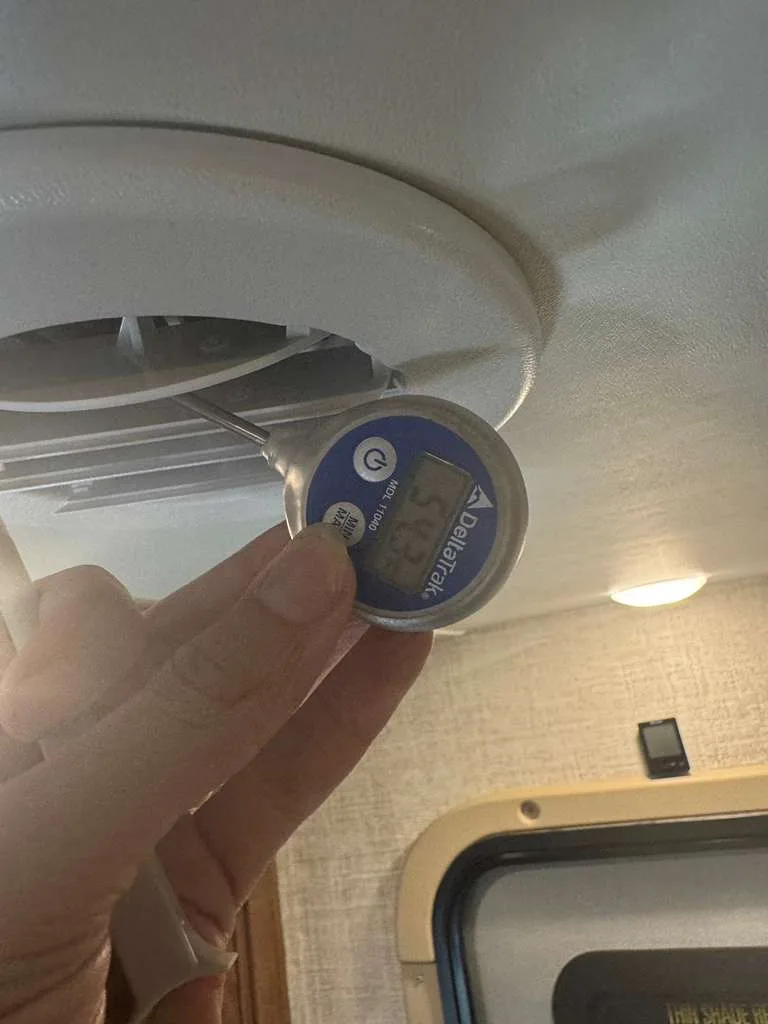
Installation involves reconnecting the wire terminals according to the wiring diagram (photographed before removal), replacing the cover panel, restoring power, and running the unit through a complete operational test cycle. We measure the supply air temperature to confirm the compressor is running and the system is achieving proper cooling output before we leave.
Dual-Run Capacitors and Single-Run Capacitors
Some RV air conditioners use a dual-run capacitor - a single component with two separate capacitance values, one for the compressor and one for the fan motor. Others use two separate single-run capacitors. The distinction matters because a failed dual-run capacitor affects both the compressor and the fan motor, while a failed single-run capacitor affects only one of them.
In practice, the most common scenario is the compressor's capacitor failing first. If the fan motor capacitor also fails (which shows up as a fan that doesn't reach full speed or makes a humming noise without starting), we address both in the same service call.
We carry both dual-run and single-run capacitors for the most common RV AC brands. For units where we don't have the exact specification on the truck, we can source next-day delivery to your Winter Haven location.
Cost of RV AC Capacitor Replacement in Winter Haven
Capacitor replacement is the most cost-effective AC repair available. Parts cost ranges from $8 to $35 depending on the capacitor specification. Labor for the replacement - including safety discharge, testing, installation, and operational verification - brings the total to $120 to $180 at your location in Winter Haven.
To put this in context: a failed compressor resulting from repeated failed start attempts on a bad capacitor runs $500 to $750 in parts and labor. A full unit replacement runs $800 to $1,400 installed. The $150 capacitor replacement that catches the failure before compressor damage occurs is among the highest-value repairs in RV service.