Understanding Why Your RV AC Runs But Doesn't Cool
There are few more frustrating RV experiences than turning on the air conditioner on a hot Winter Haven afternoon, hearing it run, and watching the interior temperature stay at 92 degrees. The unit is obviously doing something - the fan is blowing, the thermostat is set correctly, the breaker is on. But the air coming out of the vents is barely cooler than the air going in.
This specific symptom - an RV AC that runs but doesn't cool - is distinct from an AC that won't start at all. When the unit runs without cooling, you have narrowed the problem significantly.
The electrical system is delivering power, the control board is functioning, and the indoor fan motor is operational. The failure is happening somewhere in the cooling cycle itself.
In Winter Haven's climate, this problem peaks between June and September when daytime temperatures regularly exceed 95 degrees and humidity runs at 70 to 90 percent. The thermal load on an RV roof-mounted AC unit in full Florida sun is extreme - the system is working at maximum capacity for 6 to 10 hours per day, and any component that is marginal will fail under that sustained stress.
The Four Most Common Causes in Winter Haven
Based on our service calls across Winter Haven and Polk County, here are the failure patterns we encounter in order of frequency.
1. Failed Run Capacitor (Most Common - ~40% of Calls)
The run capacitor is a small cylindrical component mounted inside the AC unit housing near the compressor. Its job is to store an electrical charge and release it as a startup boost to the compressor motor. When it degrades - which happens faster in Florida's heat than almost anywhere else - the compressor cannot develop the starting torque it needs to begin the refrigeration cycle.
The symptom is characteristic: you hear the indoor fan motor start normally, then a brief click or hum as the compressor attempts to engage, then nothing. The compressor never locks in. The unit blows air at ambient temperature (or very slightly cooler from the fan moving air through the coils).
Capacitor replacement is our fastest fix. We keep capacitors for Dometic, Coleman-Mach, and Advent Air on every service truck.
The repair takes 20 to 30 minutes from arrival to completion. If you call us at (863) 294-7800 and describe this specific symptom, we can often diagnose the capacitor over the phone before arriving.
2. Frozen Evaporator Coil
A frozen coil produces a specific pattern: the AC starts cooling normally, but over 20 to 40 minutes the airflow progressively weakens as ice builds up on the evaporator coil and blocks the airflow path. Eventually the unit may blow almost no air at all despite running.
Three causes lead to frozen coils: a dirty or clogged air filter that restricts airflow over the coil, low refrigerant charge that causes the coil to run too cold, or a failing indoor blower motor that reduces airflow. The filter is the first thing to check - a severely restricted filter can freeze the coil rapidly in Florida's humidity.
When we arrive at a frozen coil call, we first need to let the coil thaw - typically 2 to 4 hours with the AC fan only running (no compressor). We then identify and address the root cause: filter cleaning, refrigerant check, or motor evaluation. We do not simply clear the ice and leave - that only repeats the problem.
3. Low Refrigerant Charge
RV air conditioners use R-410A refrigerant in a sealed system. Unlike automotive AC, RV AC systems are not designed to be routinely serviced for refrigerant - the system is sealed from the factory and should not lose refrigerant unless there is a leak.
Low refrigerant produces weak cooling across all conditions - the AC may cool somewhat, but it never achieves the 20-degree temperature drop that a properly functioning unit delivers. We check for leaks before recommending a recharge. Adding refrigerant to a leaking system only delays the next failure by a few weeks.
4. Failing or Failed Compressor
Compressor failure is the most expensive diagnosis and the one that drives the repair-versus-replace decision. A failing compressor typically shows up as weak cooling that gets progressively worse over a few weeks before stopping entirely. A failed compressor produces no cooling whatsoever despite all other components functioning.
For RV AC units under 10 years old and in good overall condition, compressor replacement may be economical. For units over 12 years old in Florida conditions, we typically recommend evaluating a full unit replacement - the compressor makes up 60 to 75 percent of a new unit's cost, and replacing only the compressor leaves you with all the other aged components.
How We Diagnose an RV AC That Isn't Cooling
Our diagnostic sequence on a not-cooling call is systematic and takes 15 to 20 minutes. We start with the power supply - verifying voltage at the unit and confirming the correct amperage draw.
An AC unit pulling below its rated amperage indicates the compressor is not running. An AC unit pulling its rated amperage but producing warm air indicates a refrigerant or coil issue.
We check the capacitor with a capacitance meter. A capacitor rated at 35 microfarads reading 28 or below on our meter is failing and should be replaced regardless of whether it is the primary symptom. Marginal capacitors can cause intermittent cooling problems and hard compressor starts that accelerate compressor wear.
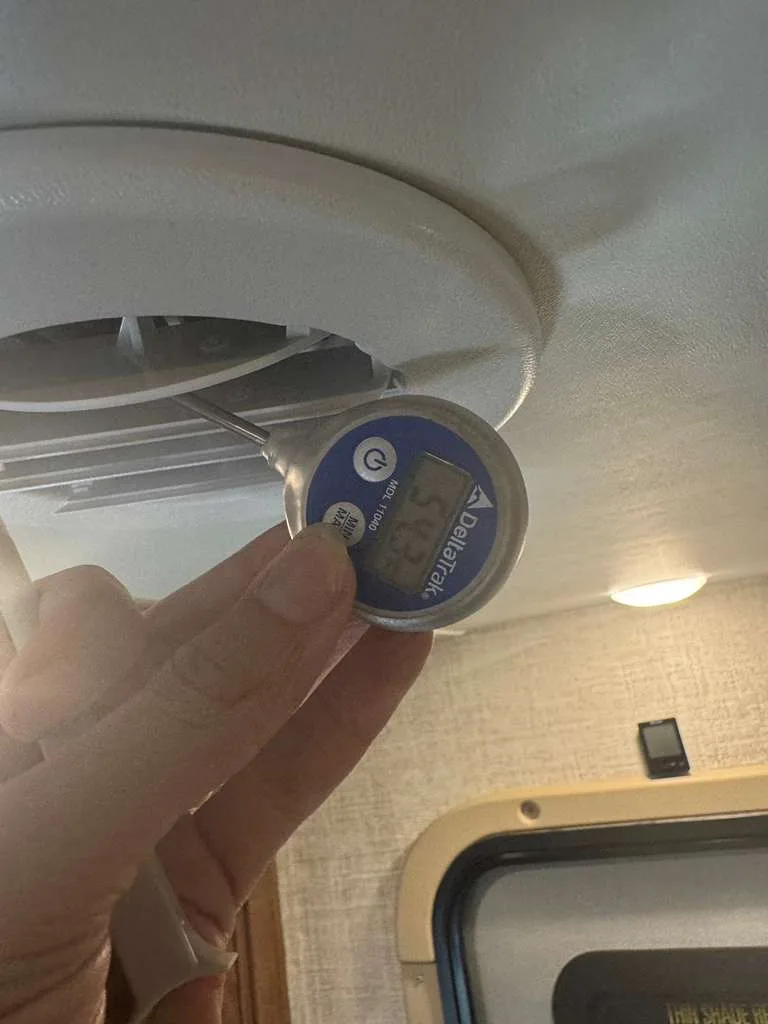
We check supply air temperature with a thermometer - a properly functioning RV AC should produce supply air at least 16 to 20 degrees below ambient temperature. Output in the range of 5 to 10 degrees below ambient with a running compressor points to refrigerant issues. Output at ambient temperature with a running fan and no compressor engagement points to capacitor or compressor issues.
Based on what we find, we give you a clear diagnosis and a flat-rate quote before touching anything. You approve the repair, we complete it on-site, and we run the unit through a 20-minute test cycle under load to verify the repair before we leave.
What Preventive Maintenance Prevents This in Winter Haven
Florida's year-round camping climate means your RV AC works significantly harder than in seasonal climates. A few maintenance steps extend the life of your AC and reduce the chance of a summer failure.
Clean or replace the return air filter every 60 to 90 days during active Florida camping season. A clogged filter is the single most preventable cause of frozen coil and reduced cooling performance. The filter is typically accessible from inside the rig - remove the ceiling diffuser panel, slide out the foam filter, wash it with mild soap and water, let it fully dry, and reinstall.
Have the unit inspected annually, including capacitor testing. Capacitors degrade gradually before failing completely. A capacitor test during a routine service call catches a failing capacitor before you discover it at noon in July on your first hot day at Masterpiece RV Resort.
Keep the outside coils clean. The condenser coils on the top of the unit are exposed to everything your rig travels through - road dust, cottonwood, insect debris. Clean the coils gently with low-pressure water (not a pressure washer) once per season to maintain heat transfer efficiency.